Monday, November 28, 2011
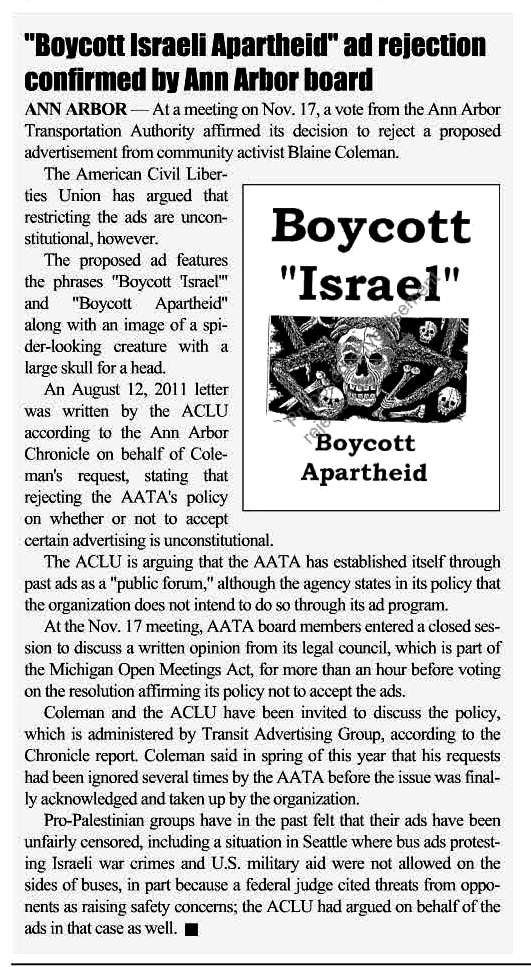
"Boycott Israel" advertisement rejected by Ann Arbor Transportation Authority (AATA)
Sunday, November 27, 2011
" 'Boycott Israeli Apartheid' ad rejection confirmed by Ann Arbor board"
Tuesday, November 8, 2011
"The university has faced intense pressure from an organized and momentous Boycott, Divestment, Sanctions (BDS) campaign..."

Above: Tree representing depopulated Palestinian Village left outside Carleton University President's office. (Photo by Derek Atkinson)“We are here to protest our university’s proud support of the Jewish National Fund’s annual gala and to challenge President Runte’s position as honorary co-chair of this event,” Dax D’Orazio, spokesperson for Students Against Israeli Apartheid (SAIA), told the Media Co-op.
A flyer circulated before the event accused the JNF of being an “openly racist organization…complicit in ethnic cleansing, colonization and dispossession in Palestine since 1901.” The historic mandate of the JNF was to remove all Palestinians from their land.
Recently, Israel has engaged in a campaign of demolishing Bedouin villages and displacing the indigenous population in the Negev Desert region. The JNF has been accused of stationing bulldozers on the land under police protection in order to clear the land for tree planting and prevent the Bedouins from moving back into the area.
Carleton students and supporters gathered in the Unicentre Atrium for a boisterous rally and then proceeded to President Roseann Runte’s office, who will participate as an honorary co-chair of the fundraiser scheduled for Tuesday, Nov. 8.
“Our goals are very clear,” said D’Orazio. “We want Runte to step down as honorary co-chair. We want the institution to distance itself from the JNF, and more broadly we want the university and the administration to explain how and why this decision was made to throw their weight behind the JNF.”
The demonstrators were prevented from entering the President’s office as doors were locked and guarded by campus security.
Protestors left three dead trees outside President Runte’s office to symbolize the depopulation of three Palestinian villages – Dayr Ayyub, Yalu, and Imwas – which were cleared so that the JNF could build Canada Park.
A few minutes before the rally commenced, an email was sent from the President’s office to the Carleton community. The email stated that, “Carleton is a part of the Ottawa community and the JNF’s Negev dinner is an event that honours community builders and leaders and I am pleased that we have been invited to participate.”
In the weeks leading up to the fundraiser, SAIA helped collect and deliver upwards of 800 letters to the university administration and organized students, faculty, and alumni to flood the President’s office with hundreds of phone calls.
The university has faced intense pressure from an organized and momentous Boycott, Divestment, Sanctions (BDS) campaign demanding that Carleton divest from companies complicit in Israeli apartheid. After a disruptive rally this past spring, which effectively shut down a Board of Governors meeting at Carleton, the university administration threatened students with non-academic penalties if they participated in similar actions in the future.
In particular, students have called out President Runte on the claim that Carleton and its officials do not wish to “take sides”. In the 2008-2009 Israeli bombardment of the Gaza Strip, which killed over 1,400 Palestinians, students asked Runte to condemn the deliberate bombing of the Islamic University in Gaza. The university's response pleaded neutrality, “…if the president has a personal opinion, he or she should not use the position of president to give it expression and weight. By so doing, it could be implied that this position was one adopted by the institution as a whole.”
As a result of this statement and the university’s inaction surrounding the BDS campaign, students are accusing the President of outright hypocrisy for sponsoring and participating in the JNF event.
Threats from the administration have not deterred Carleton students and faculty from launching effective campaigns and holding large demonstrations on campus.
According to D’Orazio, these threats have “had the effect of bolstering more support on campus and even emboldening student activists.”
SAIA plans to organize another rally to confront the Board of Governors at their meeting at the end of November.
U.S. military shoots 1.8 billion bullets per year.
They are forced to import bullets from Israel.
US forces have fired so many bullets in Iraq and Afghanistan - an estimated 250,000 for every insurgent killed - that American ammunition-makers cannot keep up with demand. As a result the US is having to import supplies from Israel.
A government report says that US forces are now using 1.8 billion rounds of small-arms ammunition a year. The total has more than doubled in five years, largely as a result of the wars in Afghanistan and Iraq, as well as changes in military doctrine.
"The Department of Defense's increased requirements for small- and medium-calibre ammunitions have largely been driven by increased weapons training requirements, dictated by the army's transformation to a more self-sustaining and lethal force - which was accelerated after the attacks of 11 September, 2001 - and by the deployment of forces to conduct recent US military actions in Afghanistan and Iraq," said the report by the General Accounting Office (GAO).
Estimating how many bullets US forces have expended for every insurgent killed is not a simple or precisely scientific matter. The former head of US forces in Iraq, General Tommy Franks, famously claimed that his forces "don't do body counts".
But senior officers have recently claimed "great successes" in Iraq, based on counting the bodies of insurgents killed. Maj-Gen Rick Lynch, the top US military spokesman in Iraq, said 1,534 insurgents had been seized or killed in a recent operation in the west of Baghdad. Other estimates from military officials suggest that at least 20,000 insurgents have been killed in President George Bush's "war on terror".
John Pike, director of the Washington military research group GlobalSecurity.org, said that, based on the GAO's figures, US forces had expended around six billion bullets between 2002 and 2005. "How many evil-doers have we sent to their maker using bullets rather than bombs? I don't know," he said.
"If they don't do body counts, how can I? But using these figures it works out at around 300,000 bullets per insurgent. Let's round that down to 250,000 so that we are underestimating."
Pointing out that officials say many of these bullets have been used for training purposes, he said: "What are you training for? To kill insurgents."
Kathy Kelly, a spokeswoman for the peace group Voices in the Wilderness, said Mr Bush believed security for the American people could come only from the use of force. Truer security would be achieved if the US developed fairer relations with other countries and was not involved in the occupation of Iraq. The President, said Ms Kelly, should learn from Israel's experience of "occupying the Palestinians" rather than buying its ammunition.
The GAO report notes that the three government-owned, contractor-operated plants that produce small- and medium-calibre ammunition were built in 1941.
Though millions of dollars have been spent on upgrading the facilities, they remain unable to meet current munitions needs in their current state. "The government-owned plant producing small-calibre ammunition cannot meet the increased requirements, even with modernisation efforts," said the report.
"Also, commercial producers within the national technology and industrial base have not had the capacity to meet these requirements. As a result, the Department of Defense had to rely at least in part on foreign commercial producers to meet its small-calibre ammunition needs."
A report in Manufacturing & Technology News said that the Pentagon eventually found two producers capable of meeting its requirements. One of these was the US firm Olin-Winchester.
The other was Israel Military Industries, an Israeli ammunition manufacturer linked to the Israeli government, which produces the bulk of weapons and ordnance for the Israeli Defence Force.
The Pentagon reportedly bought 313 million rounds of 5.56mm, 7.62mm and 50-calibre ammunition last year and paid $10m (about £5.5m) more than it would have cost for it to produce the ammunition at its own facilities.
*************************************
Monday, November 7, 2011
"University of Michigan students walk out in protest of Israeli diplomat"-- Ann Arbor, Michigan campus

ANN ARBOR — Last year, the a coalition of University of Michigan student organizations set off a national college trend with their walk-out on a pair of Israeli soldiers at a speaking tour on campus that many deemed a PR campaign to "whitewash" UN war crimes accusations.
Saturday, November 5, 2011
November 1, 2011:
"Students protest Israeli spokesperson at Wayne State University"
Sunday, September 18, 2011
Boycott-Israel campaign at Sacramento, California food co-op
By SHANE GOLDMACHER
Los Angeles Times
September 9, 2011
Reprinted in the Sacramento Bee at:
http://www.sacbee.com/2011/09/09/3897181/food-co-op-turns-into-battleground.html
"...A small band of members pushed the co-op board to strip store shelves of Israeli-made items, arguing that Israel represses its Palestinian population and the co-op should take a stand. They collected signatures and demanded a referendum on the issue, but the board said no. So the activists launched a campaign to take over some board seats. Votes will be tallied Saturday...
"...Similar battles have flared at co-ops across the nation: in Brooklyn, N.Y. (still going), Ann Arbor, Mich. (boycott rejected), Olympia, Wash. (boycott adopted). They're loosely linked through the Boycott, Divestment and Sanctions movement modeled after the old anti-apartheid boycotts."